
Residents Take City to Court Over Plan to Bomb-Proof World Trade Center

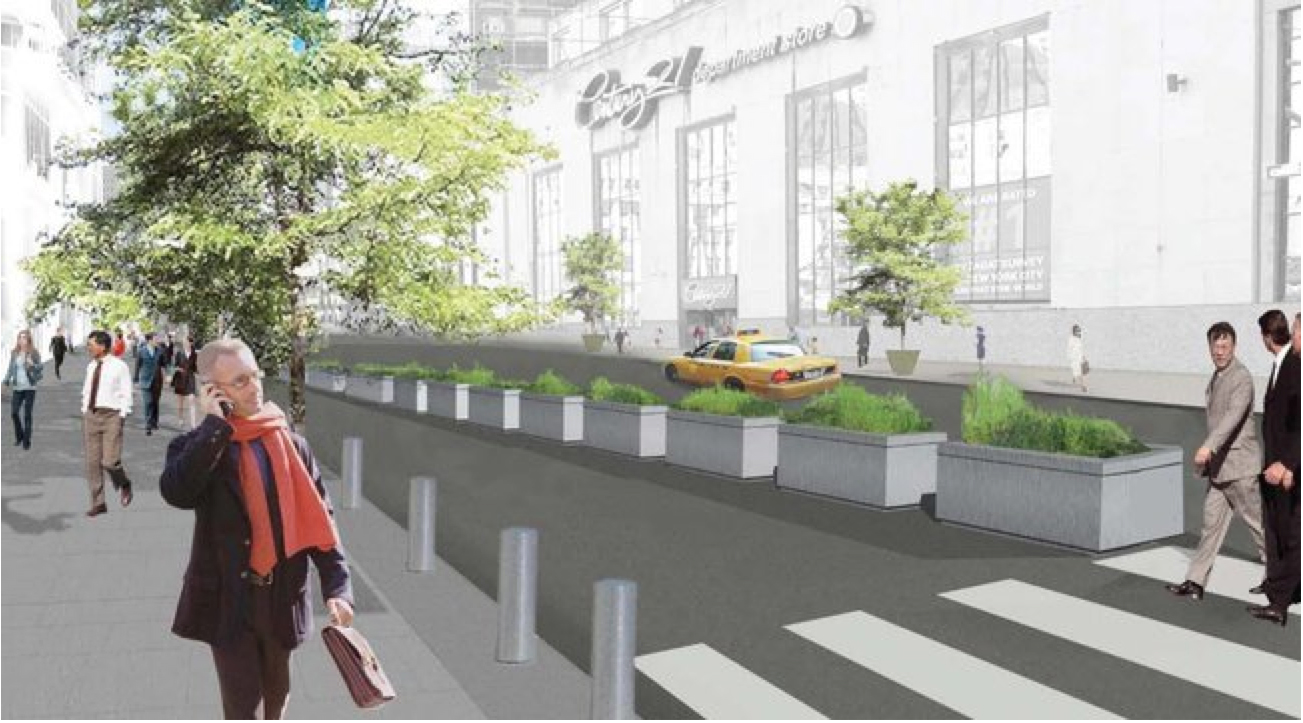
The Police Department's proposed security checkpoint at West Broadway between Barclay and Vesey streets. Rendering: NYPD
Fearing the NYPD’s plan to bomb-proof the World Trade Center will cut them off from “free access to the outside world,” residents who live near the site were in court last week to try to stop the plan from moving forward.
The residents, most of whom live on Liberty and Cedar streets, view the barriers and checkpoints that will ring the site as overly cautious and sure to hem them in with crowds and traffic. And they claim that the city failed to adequately study the environmental impacts of its security measures or to fully consider alternatives.
 In their first court appearance since the lawsuit was filed in November, lawyers for the city and for the opponents, who call themselves the “World Trade Center Neighborhood Alliance,” argued their cases before state Supreme Court Judge Margaret Chan.
The judge withheld her decision pending a “field trip” to the area. “My assessment,” she said, “is that Liberty Street doesn’t want to be renamed ‘No Liberty Street.’”
Under what is being called the World Trade Center Campus Security Plan, vehicle screening stations would be installed on streets leading to the World Trade Center. The plan also involves closing off the west lane of Church Street, between Cedar and Vesey, to general traffic. Pedestrians could freely access the site, and a “Trusted Access Program” would allow “expeditious entry” for the vehicles of area residents and businesses.
Although construction has already begun on some of the security installations, the opponents are holding out hope that they can convince the judge that the city needs to stop and reconsider its plan.
“We’re trying to impress upon you that they’re overpolicing, that it’s security for security’s sake, and that it doesn’t benefit anyone including the people who live there, who work there, who are going to museums,” argued their attorney Dan Alterman.
“When you’re considering this,” he added, “consider the fact that the plan should be scaled down.”
The city, arguing that the Campus Plan was “well considered” and “publicly vetted,” accused the residents of second-guessing its anti-terrorism experts. It did consider alternative security measures, the city contended in court papers. Those proposed by the opponents, it said, would be “inadequate because they would not enable the NYPD to stop hostile vehicles from entering the campus, which would leave the WTC campus vulnerable to further attacks.”
Traffic patterns will be monitored, the city said, and adjustments to the plan will be made as needed.
In the meantime, petitioner Kathleen Moore, a resident of 125 Cedar, an apartment building that faces the World Trade Center, said the judge’s wish to tour the site’s perimeter is “extremely promising.”
“If we can at least reconsider what’s been developed by the Police Department and take a new look at the neighborhood,” she told the Trib, “it would be wonderful.”
Comments
'WTC security plan will affect entire Lower Manhattan community'
As a member of the World Trade Center Neighborhood Alliance, I want to correct some parts of your recent article. First, and most important, the NYPD security plan will affect the entire Lower Manhattan community, and not just the adjacent streets to the World Trade Center as the article implies. The extraordinary security measures being taken, which an independent security firm has challenged, will lead to massive traffic tie-ups that will affect all surrounding neighborhoods including Battery Park City, Tribeca, the Financial District and Soho. For example, the plan calls for tour buses (as many as 42 per hour at peak) to come directly to the site, whereby the west lane of Trinity will be for tour buses requiring credentialing at the intersection of Liberty and Trinity. Each bus will take several minutes to search and clear, then passengers have to be unloaded, and the buses will park in the area, it becomes easy to see how the streets surrounding the trade center will become quickly congested, especially in light of the fact that the opening of WTC4 and 1 will bring an extraordinary amount of extra traffic. We say move the buses away and have tourists come by New York City subway where even the City noted in court that over 11 subway lines converge in the area. The Trade Center will already add much more traffic to the neighborhood as the buildings open and get necessary services and supplies delivered to the site.
This plan has the potential for significant adverse impacts on the viability of Lower Manhattan to remain a haven for new residents and businesses, particularly as the area grows in leaps and bounds over what it is today. Just think about the 10/10 Firehouse at Liberty and Greenwich—with the streets clogged with buses, how will the fire trucks get in and out? For that matter, how will emergency vehicles, ambulances, police vehicles, be able to access the site and surrounding neighborhoods? So this issue extends far and wide throughout Lower Manhattan is not just a few people who feel the plan will “hem them in with crowds and traffic.”
Furthermore, despite what the City says, the NYPD did not take into consideration the views of the community and completely ignored every comment and suggestion. The original and still best plan for the Lower Manhattan and the World Trade Center site is an integration with surrounding neighborhoods, not a walled-off security zone. As a survivor of 9/11 who lived at the time and still does live directly across the street from the WTC, security is paramount to me, my family, my friends and neighbors, and citizens and visitors to the site, but this plan will as it is currently constituted have an exceedingly detrimental effect on life in all of Lower Manhattan.
Steven Abramson, Mary Perillo and the WTC Neighborhood Alliance