
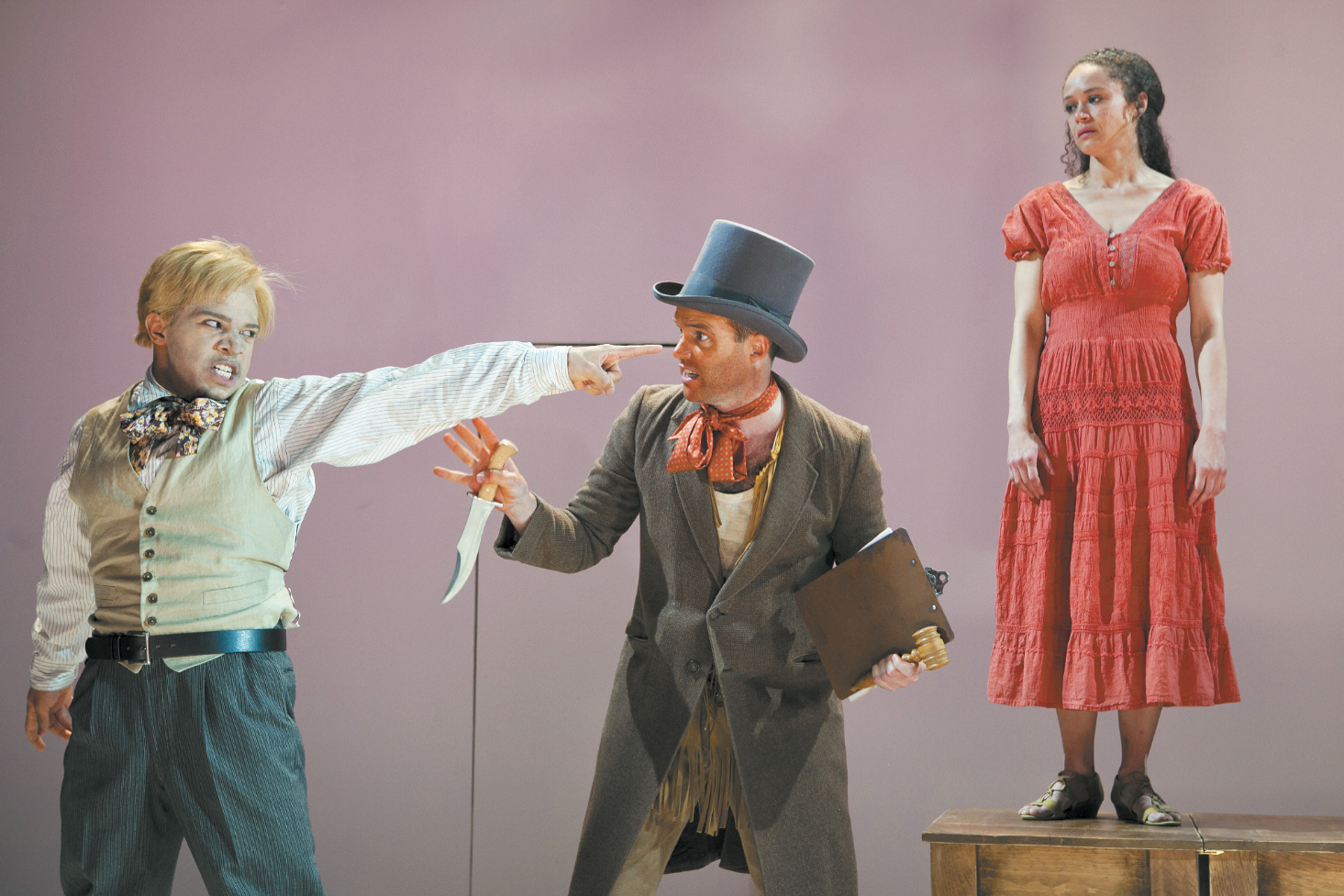
Chris Myers, Danny Wolohan, Amber Gray in a scene from “An Octoroon.” Photo: Pavel Antonov
Could the world premiere of “An Octoroon,” set on a cotton plantation in the 19th century, have opened at a more relevant time, when the subject of racism is in the headlines.
The woman at the center of “An Octoroon,” this intriguing and many-layered play now at Soho Rep, is one-eighth black, and as such she can’t marry the white man she loves and is in danger of being sold as a slave.
I got back from a performance of this intriguing and many layered play to find my family watching the first Los Angeles Clippers game post-Sterling. Perfect timing.
Layer one to peel away is that the writer, the prodigiously talented 29-year-old Branden Jacob-Jenkins, based it on an 1859 hit of the same name. The original, by Dion Boucicault, opened at a theater just north of Tribeca and it was so popular that seven companies toured with it around the country for years.
The first “Octoroon” tells the story of a debt-ridden plantation and the slaves who work there after the owner’s death. George, a young artist, is set to inherit the place but he falls in love with Zoë, the beautiful octoroon of the title. An evil rival, the overseer M’Closky, has designs on Zoë too. All seems lost as one melodramatic development piles upon another. But justice is served in a twist that hinges on a Native American chief played in the original by Boucicault himself, and what was then a newfangled contraption—a camera.
The updated “Octoroon” stays faithful in large part to this plot and includes a good dose of melodrama. But then it begins to get way more complicated. For a start, Chris Myers pulls off the daunting feat of playing three parts—the contemporary character of writer Jacobs-Jenkins, the lovestruck George and his rival M’Closky. The latter two are white, so in a reversal of the original, Myers, who is African-American, dons white makeup. But as in the 1859 play, Ben Horner appears in blackface to play a slave—back then African-Americans weren’t even allowed in the theater.
An excellent cellist, Lester St. Louis, plays the incidental score by Cesar Alvarez and it all somehow comes together under Sarah Benson’s pacy direction.
There’s a ditzy white socialite (Zoë Winters) and a giant Brer Rabbit played by the playwright. Large objects fall, there’s a blizzard of cotton balls, and it’s shocking and uproariously funny in turns. Funny? Aren’t we talking about slavery?
“I made the slaves sound like people I know,” said Jacob-Jenkins after a recent performance. “My great-grandfather was a sharecropper in Arkansas and I was interested in capturing what I imagine to be the boredom of being a slave.”
The three women slaves in the play may be bored but they’re anything but boring. Shyko Amos, Jocelyn Bioh and Marsha Stephanie Blake threaten to steal the show with their sassy, wisecracking, psychobabbling chorus. One moment, they are discussing how many times they have been bought and sold as property, the next they sound like they’re over- sharing on a daytime talk show.
We are brought back to the tragic heart of this story and its resonance over the years by Amber Gray in her poignant performance as the virtuous but doomed Zoë who could “pass” as white except she’s not considered to be white.
Zoë says, “For every seven drops of red blood in my veins, one is black,” and she points to the bluish whites of her eyes as proof of her origins. It’s sobering to realize through recent events that some people are still obsessing about these differences.
Donald Sterling and his ilk should come to Tribeca to see this play.
“An Octoroon” by Branden Jacobs-Jenkins, and directed by Sarah Benson, is at Soho Rep, 46 Walker St., through May 24. Running time is 2 hours 30 minutes. Tickets at sohorep.org.