
; Gail Karlsson (bird)</p>")
Left: Gail Karlsson in Battery Park. Right: Karlsson's photo of a Blue Jay, which appears in her book, "A Bird's Guide to the Battery and New York Harbor." Photos: April Koral/Tribeca Trib (Karlsson); Gail Karlsson (bird)
"It seems a little odd," notes Gail Karlsson, "that I spent most of my life not even noticing birds. But they really are pretty fascinating."
Karlsson, 70, recently published "A Birds' Guide to The Battery and New York Harbor [1]," a personal tribute to the 25-acre park's rich, and largely unknown, avian life. The book's photos of 79 varieties of birds are just a sampling of the ones she has taken during the hundreds of hours she has logged in the park. The captions, often witty, are from the bird's point of view.
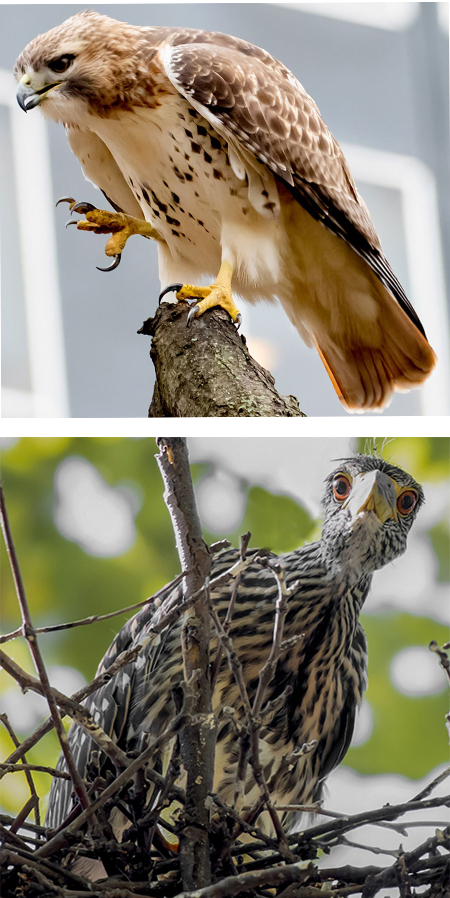 One morning last month, I met Karlsson, a longtime Tribeca resident and former environmental lawyer, at Pier A near The Battery. It had already been a pretty good day for her. She’d arrived at the park a little after 8 and for the first half hour watched a hawk hunt for food. "I've seen them here before, eating a pigeon, eating a rat. When the hawk is flying around the other birds are likely to stay quiet. Unless there's a crow." Sure enough, a few Fish Crows had soon spotted the hawk. "They started flying at it, trying to drive it off. It was pretty exciting."
Karlsson had also seen a couple of Song Sparrows and a Yellow-bellied Sapsucker. "They're a kind of woodpecker," she explained. "They love the sap of the cedar trees here." I took a closer look at the cedars that lined the path into the park and, sure enough, I saw the rows of tiny holes drilled into the trunk.
It turns out that learning to see is the first challenge for a new birder. Karlsson was quick to notice a rustle in the bushes, spots of color on a branch, an unexpected movement in the grass—all cues to the presence of a bird.
"There's a sparrow," she said, pointing to what appeared to be just a round splash of color halfway up a tree. As if on cue, the ball unfurled, revealing its wings. "You gotta learn your sparrows," Karlsson advised me. "Because that's what you'll see in the winter."
.jpg) "We're not used to looking for little birds in the trees," Karlsson said. "It took me quite a while to see them." She still remembers the excitement of spotting a grackle on one of her first walks through the park with a birding group. "A grackle looks like a small crow but it's iridescent. It was in a tree and it was eating something. I looked more closely and I realized it was a baby sparrow. It was kind of gruesome."
About 10 years ago, a college friend talked Karlsson into going birding with her. She liked it and volunteered to be a "citizen scientist" for NYC Audubon, helping collect data about birds foraging in Jamaica Bay.
Then in 2017 she read about bird walks in The Battery, which is on a spring and fall migratory route. Since the Battery Conservancy overhauled the park, filling it with native plants, it has become a popular way station for migrating birds.
The walks were once a week, but Karlsson started going to the park every day. "I had no idea that there were so many birds here. I would show my bird pictures to friends who would say, "Wow, they're in New York City? That can't be."

Karlsson likes to get to the park by 8 a.m. to catch the warblers, and other early risers, breakfasting on bugs. "If you come in the middle of the day there's less activity. They're not moving. They're sleeping or resting."
In the winter, on days when the wind was not whipping fiercely across the Hudson, she'd come a few times a week. "A lot of birds in the harbor, especially ducks, come here in the winter. You don't see them at other times."
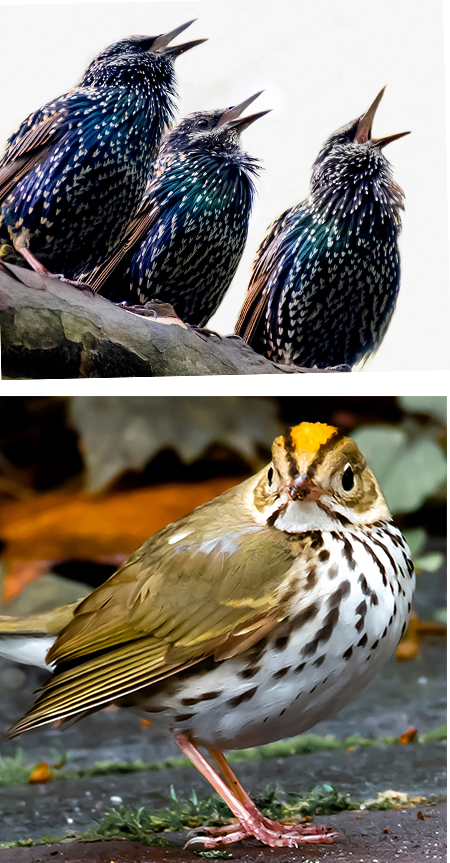 Soon after she discovered The Battery as a sanctuary for birds, Karlsson's husband became gravely ill (he is now okay), and she stepped back from her environmental work for the United Nations.
The park would soon become, she says, a sort of salvation for her in a time of despair. "I had a lot of things to worry about but I could look forward to coming down here and seeing the birds. Sometimes I would sit in that labyrinth area [in the northwest corner of the park] and listen to the birds and be in a kind of zen-like mode."
She recalled feeling "comforted" by them; they became her "companions."
"Not that they gave me advice or said how much they liked me," she said with a laugh, "but they called my attention to their lives, and that gave me a broader perspective on my own."
These were difficult years, too, for environmental activists like Karlsson who came of age professionally during the burgeoning sustainability movement. "Under the Trump administration, I saw everything I had worked for being undone," she said.
Karlsson grew quiet for a moment, then, suddenly, her face lit up.
"What's he doing?'' she asked, half speaking to herself. She was watching something move on the ground beyond the cypress trees. "It's a robin! He's pulling a worm out!"
.jpg "Great Egret. Photo: Gail Karlsson") Before leaving the park, I asked Karlsson how many types of birds she’s identified. She seemed mildly peeved by my question.
"I don't know. I'm not interested in numbers.
"You know," she added, "birds always had a spiritual role in ancient times. They were messengers connecting us to the gods. I didn't experience them that way but I do see them as showing me their way of being in the world. And maybe that's spiritual, too."
Links:
[1] https://www.amazon.com/Birds-Guide-Battery-York-Harbor/dp/0976399520