
New Voices to Enter Fray in South Street Seaport Development

The first meeting of a South Street Seaport working group convened around a conference table and was hosted by Assembly Speaker Sheldon Silver. Photo by Jason Fink/Courtesy of the Office of Assemblyman Sheldon Silver
Updated 2/28/14 following the first task force meeting.
Many voices are yet to be heard before the South Street Seaport is redeveloped.
A diverse group, picked to tackle the Seaport’s controversial future, has begun a series of closed-door discussions expected to go on for two months or more.
Only after the group has finished its work can the Hughes Corp. finalize its proposal for review by the city, which is to begin this fall.
The group is made up of Lower Manhattan civic leaders, elected officials and Hughes Corp. representatives.
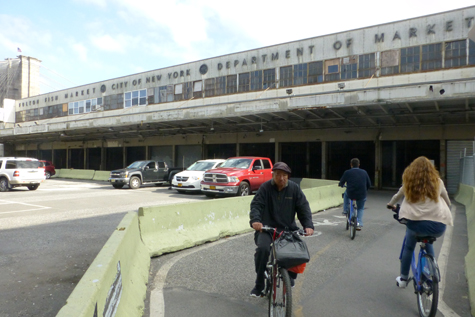
The developer’s current plans include a 50-story residential tower where the New Market Building now stands, just north of Pier 17. It is a project that has been vehemently opposed by some on the newly formed task force.
Following a standing-room-only public meeting in January where the Hughes Corp.’s plans were roundly criticized, city officials agreed to the creation of a task force—an unusual step in the approval process when city-owned land is to be redeveloped.
It is unclear how the group will come to a consensus on Seaport development, or on the kinds of givebacks—a school or affordable housing units, for example—that could be asked in exchange for relenting on a tall building. Nor is it clear how much influence the group will have on the final plans for the area.
“Of course there will be lots of discussions done professionally to make sure that this is a product that we all can be proud of,” said Manhattan Borough President Gale Brewer, who is chairing the task force along with Councilwoman Margaret Chin and State Assembly Speaker Sheldon Silver. “It is not easy.”
In a statement after its first meeting, the group said it had “successfully begun a community-driven dialogue which will hopefully help establish governing principles” for Seaport development.
Although the task force’s position will not be binding, Brewer said, “I think the weight of this discussion will be very strong, and we hope that it will be taken very seriously.”
“We welcome the community input to help us prioritize the things that are most important,” said Chris Curry, a Howard Hughes executive.
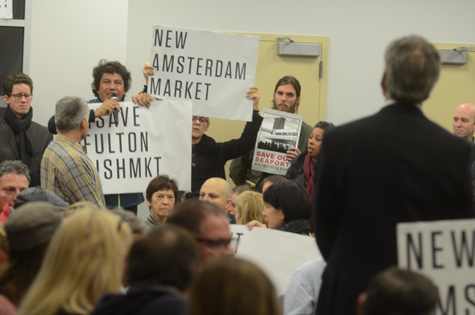
Curry previously maintained that the tower is needed to pay for Hughes Corp.’s other development proposals, such as rebuilding the piers, preserving the historic Tin Building and expanding the East River Esplanade through the Seaport. He has also indicated that the developer could play a role in saving the struggling South Street Seaport Museum.
Robert LaValva, founder of the New Amsterdam Market and a leading critic of both the plans and approval process, was not selected for the working group.
“I'm very fond of Robert,” Brewer said. “He’s not going to be at the meetings but he will be represented at the meetings.”
In a phone interview, LaValva said he was told that he was excluded because of a potential conflict of interest should the task force decide that it wants the New Amsterdam Market, rather than a Hughes Corp. project, as the preferred use for the fish market buildings.
“We’re a nonprofit organization that runs the market,” LaValva said. “It’s not as if we were some kind of business that was trying to profit from being another tenant on that site.”
Michael Levine, CB1’s planning consultant, said there is no deadline for completing the group’s work.
“The main thing is that we get to plan together with the developer prior to entering the ULURP [Uniform Land Use Review Procedure] process,” he said.
“We hope this will be a precedent that is followed with other community boards around the city.”