
Artist Targets a Tribeca Park for His Sculpture of Arrows
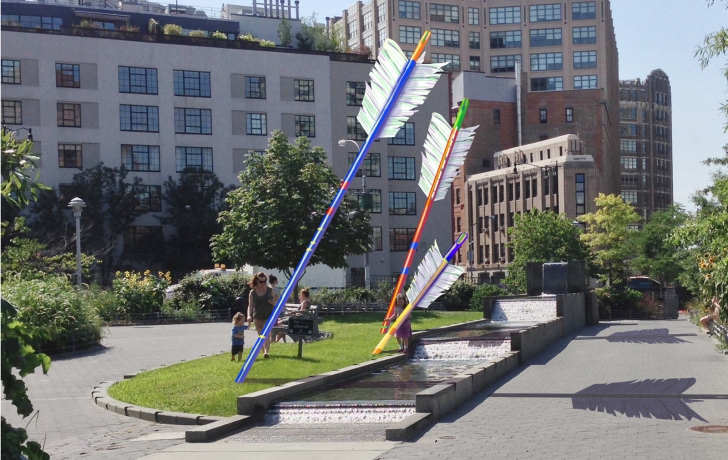
Rendering of Curtis Wallin's sculpture, Diana, which is slated to be installed in Albert Capsouto Park in April. Courtesy of Curtis Wallin
Three giant arrows will be finding their target in a Tribeca park.
Titled Diana, the trio of tubular aluminum structures, measuring from eight feet to more than 22 feet, is the sculptural concept of artist Curtis Wallin, who selected Albert Capsouto Park, at Canal Street and Sixth Avenue, as the perfect site for his one-year installation, beginning next April.
The blue, yellow and red arrows will be anchored, as if shot, into the lawn beside the park’s “canal” water feature.
 “I was looking for an open park and an open feeling, and when I saw that I thought, ‘Wow, this is what I’m looking for,’” said Wallin, 48, whose work ranges from scenic design to painting, sculpture and conceptual art. “I loved the layout of Capsouto that would allow for the visual play of the arrows against the length of the canal.”
In the mind of the artist, these arrows come from the bow of the mythological huntress Diana, whose statue by Augustus Saint-Gauden stood atop the long-vanished Madison Square Garden at Madison Square, built in 1893.
“She shot these arrows and they came down 122 years later,” Wallin said. The arrows, he noted, will be angled as if they had been shot from the perch where Diana once stood.
Wallin recalled that he had been looking for a way to “interject into a park the idea of movement and time and space and mythology all within one piece.” The inspiration for the piece, sponsored by the city Parks Department’s Art in the Parks program, came from the neon arrows he noticed that were pointing to some old parking garages in Long Island City.
“Once I saw how the arrows work in space I went home and started drawing and it just came together instantly,” he remembered. “I thought it has a really nice sense of tension. You have these large arrows; where have they come from? Why are they coming towards you? What is your place among them?”
The arrows’ bright colors, in changing contrast to the park around them, will bring freshness to the work throughout the year,” Wallin said. “It will blend into the color differently in the fall when there’s foliage around it and in winter when they’ll inject color into the park.”
“I’m praying for a good snow storm after they’re up and you see the whole world in white,” the artist added, with a laugh. “I’ll get myself down there on the first subway.”